
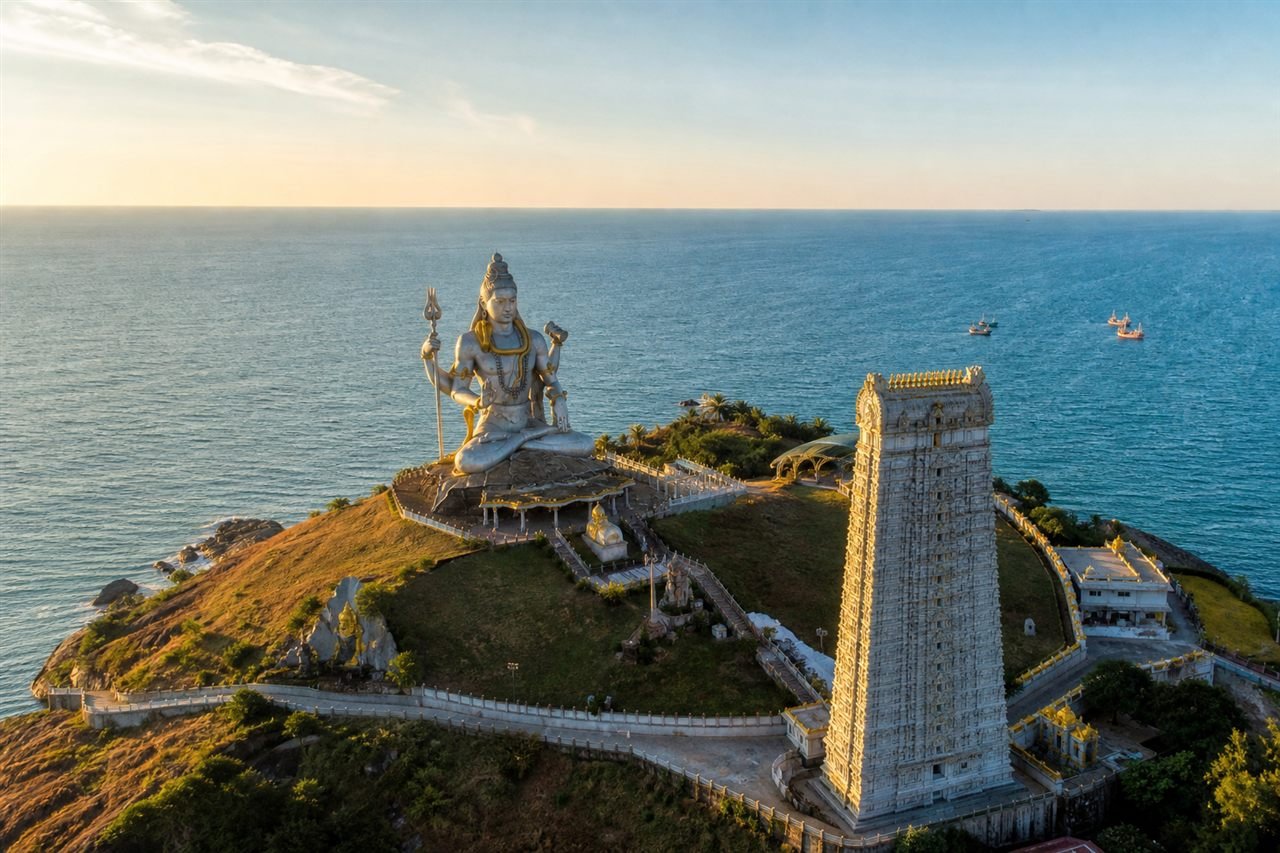
Short answers: The Murudeshwar (also spelled Murdeshwar) Shiva statue is 123 feet (37 metres) tall. It was financed by businessman and philanthropist R. N. Shetty and sculpted by Kashinath of Shivamogga with a team of artisans. The statue took about two years to build and was already standing when the 20-storey Raja Gopuram was inaugurated in April 2008.
This guide is for travellers who want the history of Murudeshwar in one place—statue height, who built it, when, the Atmalinga legend, and how to visit—with links to Karnataka Tourism, Wikipedia, and contemporary news rather than unsourced blog claims.
Murudeshwar statue and temple — quick facts
| Shiva statue height | 123 feet (37 m) |
|---|---|
| Who financed it | R. N. Shetty (Rama Nagappa Shetty), born in Murudeshwar |
| Who sculpted the statue | Kashinath of Shivamogga and a team of sculptors |
| Time to build the statue | About two years; cost often cited at about ₹50 million |
| Raja Gopuram | 20 storeys; Karnataka Tourism lists height at 249 feet; inaugurated April 2008. Lift to 18th floor: ₹20 adults, ₹10 children |
| Where | Kanduka Hill, Bhatkal taluk, Uttara Kannada, Karnataka — sea on three sides |
| Main shrine | Sri Mridesa / Murudeshwara Linga (sanctum is older than the modern statue and gopuram) |
| Temple timings | Open all days. Darshan 6:00 AM–1:00 PM and 3:00 PM–8:15 PM; closed 1:00 PM–3:00 PM |
Heights and dates below are tied to named sources at the end of this page. Where published figures differ (especially gopuram height), we say so.
How tall is the Murudeshwar Shiva statue?
The seated Shiva idol at Murudeshwar is 123 feet (37 metres) high. That figure is used by Karnataka Tourism’s Murudeshwara page and by the Wikipedia entry for Murdeshwar.
It is one of the tallest Shiva statues in the world. Wikipedia currently lists it as the third tallest, after the Statue of Belief (Vishwas Swaroopam) in Rajasthan and the Kailashnath Mahadev Statue in Nepal. Rankings can shift as new monuments open, so “among the world’s tallest” is the safer phrasing for travellers.
The statue is designed so that sunlight falls on it directly, which is why it looks especially bright in the morning and at sunset. Under the idol, visitors can enter the Bhukailasa Cave Museum, a walk-through gallery that retells the Ravana–Ganesha–Atmalinga story in sculpture—also described on the Karnataka Tourism page.
Who built the Murudeshwar statue?
Patron: Rama Nagappa Shetty (R. N. Shetty) (1928–2020), industrialist and philanthropist from Murudeshwar. His father was the hereditary Muktesar (administrator) of the temple. Shetty funded the modern temple complex and is widely credited with turning the town into a major coastal pilgrimage stop.
Sculptor: Wikipedia’s Murdeshwar page names Kashinath of Shivamogga and several other sculptors as the team that built the 123-foot idol. The same page cites an approximate cost of ₹50 million.
The Raja Gopuram (the gateway tower, not the statue) was a separate project. Contemporary coverage of its 2008 inauguration says it was built under Tamil sculptor S. K. Achar—associated with work at Vivekananda Rock, Kanyakumari—along with his sons and a large team of Thanjavur artisans, with R. N. Shetty as the driving patron. See the Daijiworld report on the gopuram inauguration (sourced from The Times of India / Sahil Online).
When was the Murudeshwar statue built?
There is no single government gazette date that every source repeats for the statue’s unveiling. What we can say with citations:
- Wikipedia: the statue took about two years to build.
- Some travel and pilgrim guides give a completion year of around 2002.
- A later Times of India feature has also mentioned 2006 in passing—so treat the exact calendar year as reported, not universally agreed.
- What is firm: by April 2008, when the Raja Gopuram was inaugurated, the 123-foot Shiva statue was already the backdrop of the complex. The Daijiworld inauguration story refers to it as already standing.
Gopuram timeline (better documented): construction is reported to have started in 1990, with a second phase from 1998, and inauguration in April 2008 by Dharmasthala dharmadhikari D. Veerendra Heggade. Wikipedia independently notes that the 20-storey Raja Gopura was constructed in 2008.
In short: the sanctum and legend are ancient; the colossal statue and 20-storey tower are late-20th / early-21st century additions funded by R. N. Shetty.
History of Murudeshwar: the Atmalinga legend
The town name comes from Mrideshwar / Murudeshwara—a form of Shiva. The temple stands on Kanduka Hill (Kanduka-Giri), a small headland with the Arabian Sea on three sides.
According to the Ramayana-linked tradition recorded on Wikipedia and retold by Karnataka Tourism:
- Ravana, king of Lanka, won Shiva’s Atma Linga (soul-linga) through intense penance, on the condition that it must not be set on the ground before he reached Lanka.
- The gods feared Ravana’s power if the linga reached Lanka. Vishnu created the illusion of dusk; Ganesha, disguised as a boy, held the linga while Ravana performed evening rites—and then placed it on the ground near Gokarna, where it became immovable (Mahabaleshwar Temple tradition).
- In rage, Ravana tried to uproot it. Coverings and fragments are said to have fallen along the coast: Sajjeshwar, Guneshwar / Gunavanthe, Dhareshwar, and the cloth covering at Mrideshwar on Kanduka Hill—today’s Murudeshwar.
The object of worship in the sanctum is the Sri Mridesa Linga, believed to be connected with that covering or fragment. Wikipedia notes the linga sits about two feet below ground level; the inner sanctum is darker and older in character than the modern outer complex. Entry into the sanctum is restricted; special sevas are done from the threshold.
Is Murudeshwar a Jyotirlinga? No. Karnataka Tourism states it is not one of the twelve Jyotirlingas, though it remains a major Shaiva pilgrimage site and is often grouped with the coastal Pancha Kshetra circuit that includes Gokarna.
The Raja Gopuram: height, lift, and 2008 inauguration
The white-and-gold gateway is as famous as the statue. Karnataka Tourism describes a 20-storey Raja Gopuram, 249 feet, with a lift to a viewpoint over the temple, town, and sea. Wikipedia’s article on R. N. Shetty instead lists the gopuram at 237.5 feet (72 m). We report both: use 20 storeys + lift as the visitor fact; treat the exact foot figure as varying by source (tourism board and 2008 news say 249 ft).
The April 2008 Daijiworld story (TOI / Sahil Online) adds contemporary detail:
- Inaugurated by D. Veerendra Heggade of Dharmasthala.
- R. N. Shetty described 21 floors including the ground floor, with a lift to the top—unusual for a gopuram.
- Base measurements given as 105 feet by 51 feet.
- Sculptural work led by S. K. Achar with sons Dakshinamurthy and Swaminathan and a large Thanjavur team.
Two life-size concrete elephants guard the steps—an image almost every visitor photographs.
Raja Gopuram lift: timings, ticket, and view
You can travel up the 20-storey Raja Gopuram by lift. It generally runs daily in two slots, matching the temple’s midday break, and stops at the 18th floor for panoramic views of the Shiva statue and the Arabian Sea.
| Lift hours | 7:00 AM – 1:00 PM 3:00 PM – 8:00 PM (daily) |
|---|---|
| Where it stops | 18th floor (views of the Shiva statue and Arabian Sea) |
| Entry ticket | ₹20 for adults, ₹10 for children |
Ticket rates as shown in visitor footage on Instagram. Fees and hours can change—confirm at the counter before you queue.
Murudeshwar Temple timings and daily rituals
The temple is open all days of the week. Darshan, pooja, and Rudrabhishekam follow this daily schedule:
| Time | Ritual / darshan |
|---|---|
| 6:00 AM – 1:00 PM | Darshan |
| 6:30 AM – 7:30 AM | Morning pooja |
| 6:00 AM – 12:00 PM | Rudrabhishekam |
| 12:15 PM – 1:00 PM | Afternoon pooja |
| 1:00 PM – 3:00 PM | Temple remains closed |
| 3:00 PM – 8:15 PM | Darshan |
| 3:00 PM – 7:00 PM | Rudrabhishekam |
| 7:15 PM – 8:15 PM | Evening pooja |
Rudrabhishekam ticket: ₹55 for two persons. Devotees can carry required pooja materials for abhishekam; it is performed daily. Festival days can change hours—confirm on site if you travel on a peak date such as Maha Shivaratri.
Visiting Murudeshwar Temple today
Plan the statue and gopuram around morning darshan, then keep the rest of the day for beach or a Gokarna circuit.
- Entry: temple entry is free. Raja Gopuram lift tickets are ₹20 for adults and ₹10 for children.
- Dress code: modest traditional wear is enforced for the inner area—dhoti/trousers for men; saree or salwar with dupatta for women. Shorts and sleeveless tops are not allowed in the sanctum zone.
- Crowds: weekends, Ekadashi, and Maha Shivaratri are the busiest. Early weekday mornings are calmer.
How to reach: NH 66 along the coast; Murudeshwar railway station on the Konkan Railway; nearest major airport typically Mangaluru (about 165 km on tourism pages). Pair with a Murudeshwar + Gokarna tour package if you want both Atmalinga sites in one trip.
Stay near the statue and temple
The hill is compact and busy. After darshan, families and elders usually want a beach stay with breakfast rather than a room only “next to the queue.” See our stay near Shiva Temple page for a temple-first itinerary, or the family beach stay if kids need lawn, pool, and space after the crowds.
If you are comparing family options around the temple, we also published which resorts near Murdeshwar Temple work for a stay with kids. For a wider look at rooms and inclusions, start at the Murudeshwar resort overview or WhatsApp us with dates.
FAQs
How tall is the Shiva statue in Murudeshwar?
123 feet (37 metres), according to Karnataka Tourism and Wikipedia.
Who built the Murudeshwar Shiva statue?
It was financed by R. N. Shetty and sculpted by Kashinath of Shivamogga with other artisans. The gopuram was a later project involving sculptor S. K. Achar’s team.
When was Murudeshwar Temple built?
The sacred site and sanctum are tied to ancient Atmalinga tradition. The giant statue took about two years (exact unveiling year is reported as c. 2002 or 2006 depending on the article). The 20-storey Raja Gopuram was inaugurated in April 2008.
Who was R. N. Shetty?
Rama Nagappa Shetty (1928–2020) was a Karnataka industrialist and philanthropist from Murudeshwar. He funded the modern temple town and received the state’s Rajyotsava Award in 2004.
Is Murudeshwar the same as Murdeshwar?
Yes. Both spellings refer to the same town in Uttara Kannada. Maps and trains often use Murdeshwar; devotees and tourism pages use Murudeshwar / Murudeshwara.
Is Murudeshwar a Jyotirlinga?
No. It is not one of the 12 Jyotirlingas. Its importance comes from the Atmalinga / Mridesa tradition and the coastal setting.
What are Murudeshwar Temple timings?
Open all days of the week. Darshan is 6:00 AM–1:00 PM and 3:00 PM–8:15 PM. The temple remains closed 1:00 PM–3:00 PM.
What are the daily pooja and Rudrabhishekam timings?
Morning pooja is 6:30 AM–7:30 AM, afternoon pooja 12:15 PM–1:00 PM, and evening pooja 7:15 PM–8:15 PM. Rudrabhishekam is 6:00 AM–12:00 PM and 3:00 PM–7:00 PM. Ticket is ₹55 for two persons. Devotees can carry required pooja materials; abhishekam is performed daily.
Can you go up the Raja Gopuram by lift?
Yes. The lift generally operates daily from 7:00 AM–1:00 PM and 3:00 PM–8:00 PM and takes visitors to the 18th floor for views of the Shiva statue and the Arabian Sea. Tickets are ₹20 for adults and ₹10 for children.
Sources
- Karnataka Tourism — Murudeshwara (statue 123 ft; gopuram 20 storeys / 249 ft; legend; timings; not a Jyotirlinga; Bhukailasa cave)
- Wikipedia — Murdeshwar (etymology and Atmalinga chronicle; 123 ft statue; ~two years; Kashinath / R. N. Shetty; ₹50 million; 2008 gopura)
- Wikipedia — R. N. Shetty (patron biography; temple modernisation; 1928–2020)
- Daijiworld — “Murudeshwar Temple Now Tallest Gopuram in Asia” (April 2008 inauguration; 249 ft / 21 floors including ground; S. K. Achar; 1990 and 1998 construction phases)
- Times of India — facts on Murudeshwar Temple (123 ft statue; R. N. Shetty; some features cite 2006—use alongside the sources above)
- Instagram reel — Raja Gopuram lift tickets (₹20 adults, ₹10 children)
Temple hours, dress rules, and lift fees can change. Confirm locally before you travel.